 PENNANT
Frequently asked questions
Clear answers before you connect the data.
Understand the reporting logic, attribution approach, privacy boundary, and implementation responsibilities behind Pennant.
01
Product and reporting
What is Pennant?+
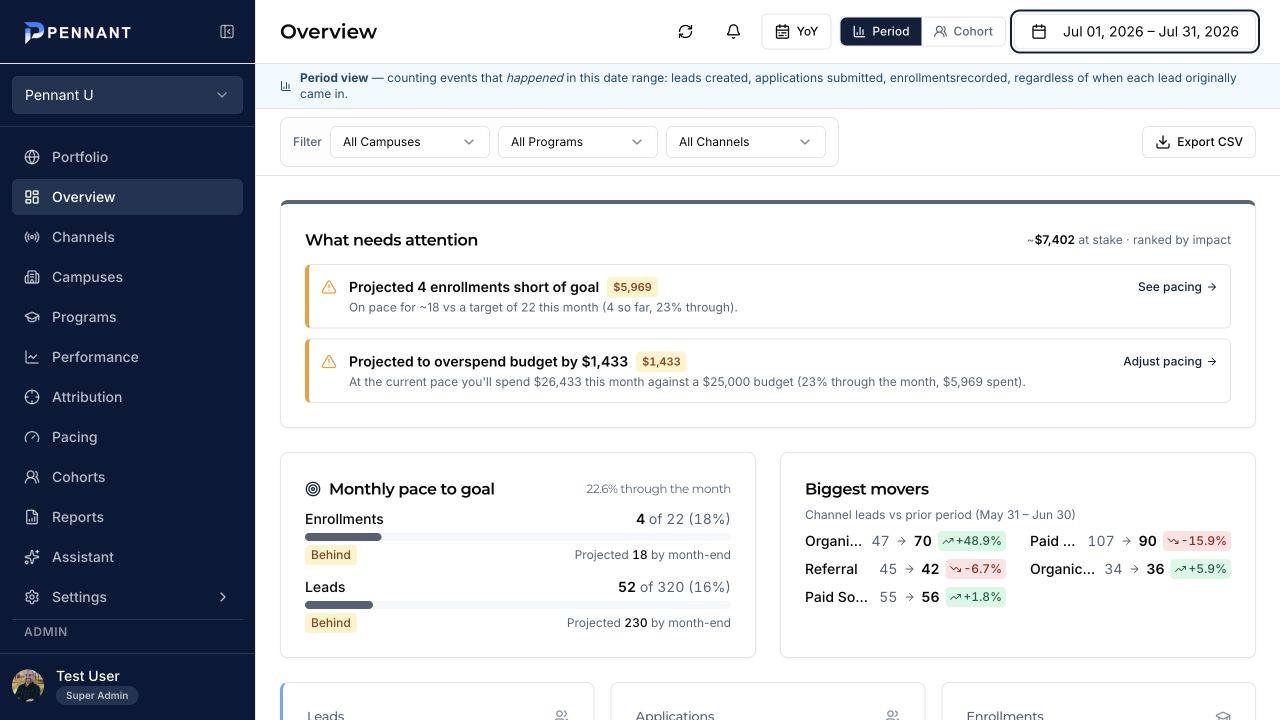
Pennant is an enrollment marketing intelligence layer for higher education. It connects advertising, CRM, budget, goal, and funnel data so teams can understand pacing, attribution, campus and program performance, and enrollment outcomes in one view.
What is the difference between Period and Cohort reporting?+
Period reporting counts events that occurred during the selected dates, regardless of when the lead entered the funnel. Cohort reporting starts with leads acquired during the selected dates and follows their later applications and enrollments.
Does Pennant support year-over-year comparisons?+
Yes. Year-over-year reporting adds the equivalent prior-year window using the same normalized metric definitions, helping teams distinguish current movement from seasonal patterns.
Can we report by campus, program, and channel?+
Yes. Pennant supports portfolio, campus, program, and channel views using shared definitions for leads, applications, enrollments, and lead-to-enrollment rate.
02
Data and attribution
How does Pennant connect advertising spend to enrollment?+
Pennant places advertising-platform spend and reported conversions beside CRM-confirmed leads, applications, and enrollments. Paid efficiency metrics use eligible paid spend and paid-source outcomes.
Why can platform and CRM conversion totals differ?+
Platforms and CRMs can use different attribution windows, identity methods, conversion definitions, and timing. Pennant keeps both perspectives visible so the difference can be understood rather than blended away.
How are CRM values standardized?+
Source values are mapped to consistent dashboard categories for channels, funnel stages, programs, and statuses. Original source values remain available as the reconciliation reference.
How often is data refreshed?+
Pennant is designed for recurring refreshes throughout the day, with historical backfills where supported. The exact cadence depends on each connected source.
03
Privacy and implementation
Does Pennant require student PII?+
Pennant can analyze pseudonymous record IDs, dates, statuses, sources, campuses, programs, and outcomes without requiring student names, emails, phone numbers, or street addresses.
Does Pennant replace our CRM or advertising platforms?+
No. Those tools remain systems of record. Pennant is the shared intelligence layer that normalizes their data and applies higher-ed reporting logic.
What does an institution provide during implementation?+
Institutions identify the agreed sources and owners, provide governed access or exports, define funnel stages and organizational dimensions, supply budget and goal context, and validate key totals and mappings.
How are data discrepancies handled?+
Differences are investigated as mapping, timing, source-definition, or data-coverage issues before the reporting view is treated as decision-ready.
Still evaluating the fit?
Bring us the question your current reports cannot answer.
We’ll show how Pennant would approach it using your reporting structure and enrollment goals.
Contact Pennant